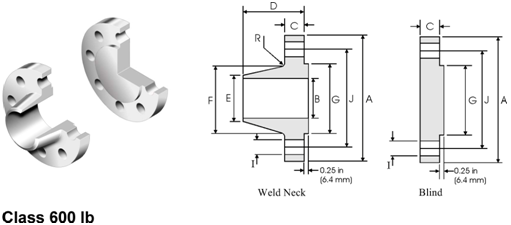
ANSI-ASME-B16-47-Flange-Series-A- MSS-SP44-Flange-class-600lbs
| Pipe Normal Diam. | O.D. OF Flange |
Thickness | Raised Face Diam. |
Diam. of Bolt Circle |
No. of Bolt Holes |
Diam. of Bolt Holes |
Diam. of Bolt |
Fillet Radius Min. |
| inch | O | C | R | BD | BN | BH | DB | r1 |
| 26" | 1016 | 125.5 | 749.3 | 914.4 | 28 | 50.8 | 1 7/8 | 12.7 |
| 28" | 1073.2 | 131.8 | 800.1 | 965.2 | 28 | 53.8 | 2 | 12.7 |
| 30" | 1130.3 | 139.7 | 857.3 | 1022.4 | 28 | 53.8 | 2 | 12.7 |
| 32" | 1193.8 | 147.6 | 914.4 | 1079.5 | 28 | 60.5 | 2 1/4 | 12.7 |
| 34" | 1244.6 | 153.9 | 965.2 | 1130.3 | 28 | 60.5 | 2 1/4 | 14.2 |
| 36" | 1314.5 | 162.1 | 1022.4 | 1193.8 | 28 | 66.5 | 2 1/2 | 14.2 |
| 38" | 1270 | 155.4 | 1054.1 | 1162.1 | 28 | 60.5 | 2 1/4 | 14.2 |
| 40" | 1320.8 | 162.1 | 1111.3 | 1212.9 | 32 | 60.5 | 2 1/4 | 14.2 |
| 42" | 1403.4 | 171.5 | 1168.4 | 1282.7 | 28 | 66.5 | 2 1/2 | 14.2 |
| 44" | 1454.2 | 177.8 | 1225.6 | 1333.5 | 32 | 66.5 | 2 1/2 | 14.2 |
| 46" | 1511.3 | 185.7 | 1276.4 | 1390.7 | 32 | 66.5 | 2 1/2 | 14.2 |
| 48" | 1593.9 | 195.3 | 1333.5 | 1460.5 | 32 | 73.2 | 2 3/4 | 14.2 |
| 50" | 1670.1 | 203.2 | 1384.3 | 1524 | 28 | 79.2 | 3 | 14.2 |
| 52" | 1720.9 | 209.6 | 1435.1 | 1574.8 | 32 | 79.2 | 3 | 14.2 |
| 54" | 1778 | 217.4 | 1492.3 | 1632 | 32 | 79.2 | 3 | 14.2 |
| 56" | 1854.2 | 225.6 | 1543.1 | 1695.5 | 32 | 85.9 | 3 1/4 | 15.7 |
| 58" | 1905 | 231.6 | 1600.2 | 1746.3 | 32 | 85.9 | 3 1/4 | 15.7 |
| 60" | 1993.9 | 242.8 | 1657.4 | 1822.5 | 28 | 91.9 | 3 1/2 | 17.5 |
Stainless Steel Blind Flanges: ASTM A182, A240 F 304, 304L, 304H, 316, 316L, 316Ti, 310, 310S, 321, 321H, 317, 347, 347H, 904L
Carbon Steel Blind Flanges: ASTM / ASME A/SA 105 ASTM / ASME A 350 , ASTM A 181 LF 2 / A516 Gr.70 A36, A694 F42, F46, F52, F60, F65, F70
Alloy Steel Blind Flanges: ASTM / ASME A/SA 182 & A 387 F1, F5, F9, F11, F12, F22, F91
Duplex Steel Blind Flanges: ASTM / ASME A/SA 182 F 44, F 45, F51, F 53, F 55, F 60, F 61
Super Duplex Blind Flanges: ASTM / ASME A/SA 182, A240 F 44, F 45, F51, F 53, F 55, F 60, F 61
Nickel Alloy Blind Flanges: Nickel 200 (UNS No. N02200), Nickel 201 (UNS No. N02201), Monel 400 (UNS No. N04400), Monel 500 (UNS No. N05500), Inconel 800 (UNS No. N08800), Inconel 825 (UNS No. N08825), Inconel 600 (UNS No. N06600), Inconel 625 (UNS No. N06625), Inconel 601 (UNS No. N06601), Hastelloy C 276 (UNS No. N10276), Alloy 20 (UNS No. N08020), etc
Copper Alloy Blind Flanges: UNS No. C10100, 10200, 10300, 10800, 12000, 12200, 70600, 71500, UNS No. C 70600 (Cu -Ni- 90/10), C 71500 (Cu-Ni-70/30)
Low Temperature Carbon Steel Blind Flanges: ASTM A350, LF2, LF3
Applications Of ASME B16.47 Series A Class 600 Blind Flanges
ASME B16.47 Series A Class 600 Blind Flanges are used in Chemical and petrochemical processing.
ASME B16.47 Series A Class 600 Blind Flanges are used in electronics.
ASME B16.47 Series A Class 600 Blind Flanges are used in processing equipment for maintaining product purity in handling foods, synthetic fibers.
ASME B16.47 Series A Class 600 Blind Flanges are used in marine and offshore engineering.
Characteristics of ASME B16.47 Series A Class 600 Blind Flanges
ASME B16.47 Series A Class 600 Blind Flanges are highly resistant to various reducing chemicals.
ASME B16.47 Series A Class 600 Blind Flanges are excellent resistance to caustic alkalies.
ASME B16.47 Series A Class 600 Blind Flanges are high electrical conductivity.
ASME B16.47 Series A Class 600 Blind Flanges are excellent corrosion resistance to distilled and natural waters.
ASME B16.47 Series A Class 600 Blind Flanges are resistance to neutral and alkaline salt solutions.
ASME B16.47 Series A Class 600 Blind Flanges are excellent resistance to dry fluorine.
ASME B16.47 Series A Class 600 Blind Flanges are widely used to handle caustic soda.
ASME B16.47 Series A Class 600 Blind Flanges are good thermal, electrical and magnetostrictive properties.
ASME B16.47 Series A Class 600 Blind Flanges offer some resistance to hydrochloric and sulfuric acids at modest temperatures and concentrations.
ASME B16.47 Series A Stainless Steel Class 600 lbs Blind Flangeis a popular type of pipe flange. It has no bore in the center,and is primarily used to close the ends of piping systems.This flange premits easy access to a line once it has been sealed.It sometimes can be machined to accept a nominal sizes pipe to which a threaded or welded reduction is being made.